
There are places in the world where history doesn’t just speak — it echoes. Literally.
One of those places is Chichén Itzá, one of the most iconic archaeological sites of the Maya civilization and home to an acoustic phenomenon that continues to fascinate travelers, researchers, and even seasoned archaeologists.
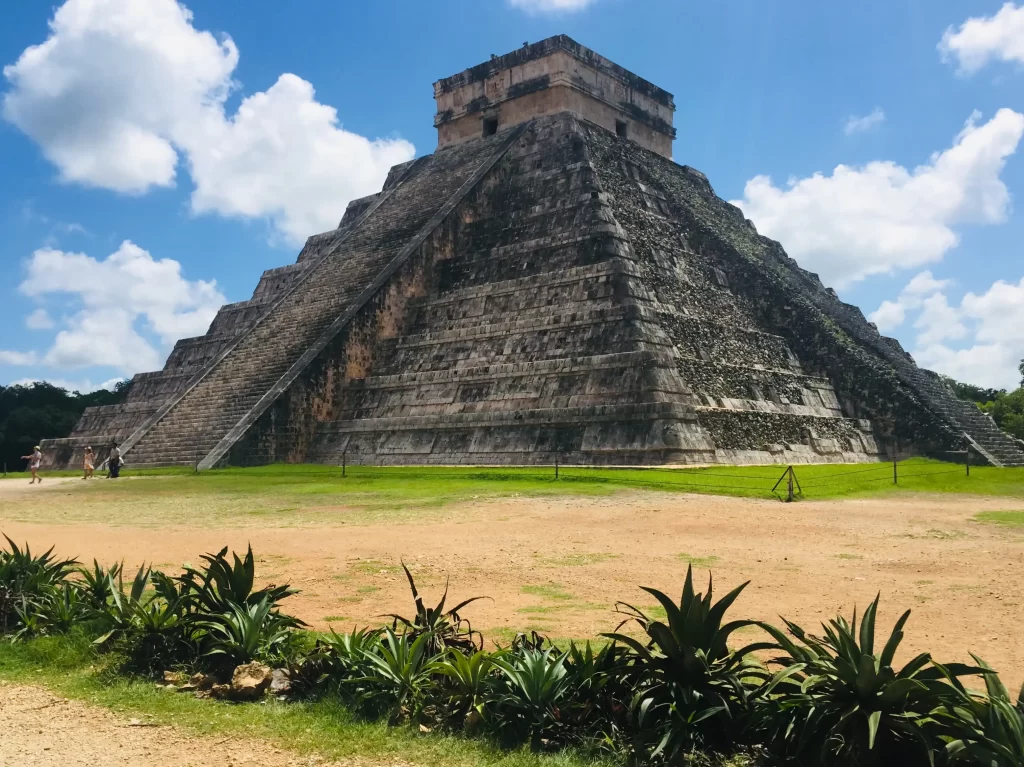
Walk in front of El Castillo, clap your hands, and the pyramid answers back.
A sound rises — sharp, chirping, bird-like.
Some describe it as surreal. Others say it feels like a message from another world.
Today, we’ll explore the Maya acoustics of Chichén Itzá, the meaning behind the Echo of Kukulkán, and why these mysterious sounds of Chichén Itzá are becoming one of the most intriguing topics for travelers and history lovers.
Introduction: When a Clap Turns Into a Message From the Past
Picture the moment:
You’re standing in the vast plaza of Chichén Itzá, the sun lighting up the steps of the pyramid. A guide asks the group to clap. The sound spreads through the air and then — it happens.
A distinct chirp replies.
It doesn’t sound like an echo.
It sounds like an animal.
This acoustic effect is not a coincidence. It is the product of architecture, science, symbolism, and extraordinary understanding of the natural environment.
And this is exactly what makes Chichén Itzá not only a visual wonder, but an acoustic masterpiece of Maya engineering.
In this article, we’ll break down:
- The secret behind the Maya acoustic design
- How the Echo of Kukulkán works
- What researchers have discovered about the pyramid’s sound behavior
- Other sound mysteries hidden across the site
- Why these acoustic features were essential in Maya spirituality and rituals
Let’s dive into one of the most fascinating soundscapes of the ancient world.
The Acoustic Genius Behind Chichén Itzá
A Pyramid Designed to Speak
The Maya were brilliant astronomers, architects, mathematicians — and surprisingly, masters of sound engineering.
Today, experts agree:
The acoustic effects around the Temple of Kukulkán were not random. They were carefully crafted through architecture and geometry.
How the Echo Works
When someone claps at the base of the pyramid, the sound travels upward and bounces against the stone steps.
Because each step is slightly inclined and uneven, the sound breaks into several pulses.
These pulses return to the listener as a high-pitch chirping echo.
Here’s the mind-blowing part:
Researchers have discovered that this echo resembles the call of the quetzal, a sacred bird in Maya culture.
That’s why some call this phenomenon:
“The Echo of Kukulkán.”
The Echo of Kukulkán: Spiritual Engineering or Scientific Coincidence?
There are two main theories — and both make the site even more fascinating.
1. A deliberate symbolic design
Many archaeologists believe the Maya intentionally created an echo that resembled the quetzal.
Why?
Because the quetzal was associated with:
- Freedom
- Divinity
- The sky
- The god Kukulkán (the feathered serpent)
Imagine the scene:
During rituals or ceremonial gatherings, priests may have used sound to “call” the sacred bird — reinforcing the connection between the heavens and the temple.
In other words:
The pyramid was designed to “speak” with the gods.
2. The acoustic effect as an architectural side product
Other experts think the sound phenomenon could have been the result of:
- The pyramid’s geometry
- The materials used
- The arrangement of the steps
But they also agree:
Even if it was accidental, the Maya quickly realized its power and integrated it into their spiritual rituals.
Either way, the result is the same:
A sound so unique that no other pyramid in the world produces it.
Other Mysterious Sounds in Chichén Itzá
The acoustic marvels don’t stop at the pyramid. Chichén Itzá is full of surprising auditory secrets.
The Great Ball Court: A Perfect Sound Tunnel
The Gran Juego de Pelota is the largest ball court in Mesoamerica — and one of the most acoustically impressive structures on Earth.
Here’s what makes it special:
- A whisper from one end can be heard over 140 meters away.
- The walls reflect sound almost perfectly.
- Voices bounce and travel with surprising clarity.
This was no accident.
It allowed rulers, priests, or spectators to hear announcements and rituals effortlessly.
Temple of the Warriors: Stone Columns and Echoes
Clapping in front of this temple produces short, sharp echoes that differ from the quetzal-like chirp of El Castillo.
Each structure in Chichén Itzá creates its own acoustic personality.
El Caracol: The “Observatory” with Whispering Effects
Known for its spiral interior, El Caracol showcases:
- Sound amplification
- Echo projection
- Acoustic patterns that follow the curves of the tower
It’s another sign that the Maya understood far more than we often assume.
Why Were the Maya So Focused on Sound?
To the ancient Maya, sound was:
- A spiritual tool
- A way to communicate with deities
- A method of guiding rituals
- An element of community gatherings
- A medium for storytelling and ceremony
Sound wasn’t just noise —
it was part of the sacred experience.
Chichén Itzá’s acoustic effects amplified rituals, turning ceremonies into immersive, multi-sensory events.
Imagine hearing the echo of a quetzal while the shadow serpent descends the pyramid during the equinox.
This combination of sound, architecture, and astronomy must have been breathtaking.
Scientific Studies: What Modern Research Reveals
Acoustic experts, physicists, and archaeologists have studied Chichén Itzá for decades.
Here’s what they’ve found:
1. The quetzal-like echo is real
Studies comparing audio frequencies show the echo matches the primary chirp of the quetzal bird.
2. The pyramid acts as a resonator
Its design scatters sound waves in symmetric patterns.
3. The ball court is acoustically unmatched
No other ancient structure channels sound with such precision.
4. The Maya had advanced understanding of environment-based acoustics
Whether intentional or discovered through trial and error, the results demonstrate architectural genius.
Tips for Visitors: How to Experience the Acoustic Phenomena yourself
If you ever visit Chichén Itzá (and you absolutely should), try these:
To hear the Echo of Kukulkán:
- Stand directly in front of the pyramid
- Clap once, firmly
- Listen closely to the returning chirp
To test the Ball Court acoustics:
- Stand at one end and speak normally
- Have someone stand at the opposite end
- You’ll hear each other with surprising clarity
For the best sound experience:
- Visit early in the morning
- Avoid peak crowds
- Stand at least 15–20 meters from El Castillo
The quieter the surroundings, the more magical the sounds.
A Pyramid That Still Speaks to Us
Chichén Itzá isn’t just a place to visit — it’s a site to listen to.
The Maya acoustics of Chichén Itzá, the resonance of the Echo of Kukulkán, and the many mysterious sounds across the site remind us of the immense scientific and spiritual knowledge of the ancient Maya civilization.
These echoes are not just physical phenomena — they are messages.
Messages that survived centuries.
Messages still waiting for us to understand them.
If you want to experience the magic of sound, history, and culture in one place, Chichén Itzá is a destination you shouldn’t miss.